

Relationship Status: “It’s Complicated”
We reach for a label when we feel lost. It is almost always too soon.

There was a version of being fifteen that happened entirely inside a dropdown menu.
You had met someone, or unmet someone, or were stuck in the long middle of something that had no agreed shape, and Facebook handed you a list. Single. In a relationship. Engaged (which was absurd). And then, further down, the one everyone reached for eventually. It’s complicated.
It clarified nothing. That was rather the point. You chose it because the situation refused to resolve into any of the cleaner options, and the menu had generously made a category for exactly that. You could be confused in public and still have selected something. The dropdown turned not knowing into a status. It let you stand somewhere.
Before my husband reads this intro and panics, I should say this is not a report on the state of our marriage.
Where the menu goes when you grow up
The menu does not disappear when you leave adolescence. It goes underground. It stops calling itself Facebook and starts calling itself your job, your marriage, the bio line you rewrite at midnight and delete by morning.
Because the impulse never actually changes. You hit a stretch of life that refuses to resolve into a clean option, and you go looking for the dropdown. You want the category that lets you stand somewhere. The woman who took the redundancy and got a leaving-do but no new title knows this. So does the one whose marriage ended and who found there was no word for what she became the next morning, only a gap where “wife” used to sit. So does the person who has quietly outgrown the role on her business card and cannot yet say what she is instead, so she keeps handing over the card, because the card at least answers the question.
We tell ourselves the label is administrative. A formality. The truth is closer to the bone. The label is where we go to stop feeling lost, and feeling lost is the thing we will do almost anything to avoid. Including choosing a status that clarifies nothing, as long as it is a status.
The nearest exit from not knowing
The reaching has a name. A psychologist, Arie Kruglanski, gave it one: the need for cognitive closure, the pull towards a definite answer on a question, any settled answer, over the discomfort of leaving it open. Under that pull we do something he called seizing. We take the first available answer that will make the not-knowing stop. Not the true one. The nearest one. The mind, handed ambiguity, would rather be wrong and settled than uncertain and still looking.
A dropdown is a closure machine. That is the whole of its function: it converts an open question into a fixed status in a single click, and the relief is real, which is why we keep reaching for it long after we have closed the tab.
None of which is a flaw in you. It is a documented feature of the standard equipment. Knowing that the pull is normal, though, is not the same as knowing what it costs you, and for that a second researcher is worth having. Writing in 1966, James Marcia set out the ways people handle the question of who they are, sorted by whether they had explored their options and whether they had committed to anything. Two of his categories sit underneath this whole piece. One he called foreclosure: taking a ready-made label and committing to it without ever exploring, because the commitment itself felt like solid ground. The other he called moratorium: the state of open exploration, no commitment yet made, the question held deliberately ajar.
Most of us rank these without thinking. The settled label looks like having your act together. The open question looks like the thing to fix. Marcia’s work quietly inverts that. The premature grab for the label is the mistake. The open, unlabelled, still-looking state is not the thing to escape.
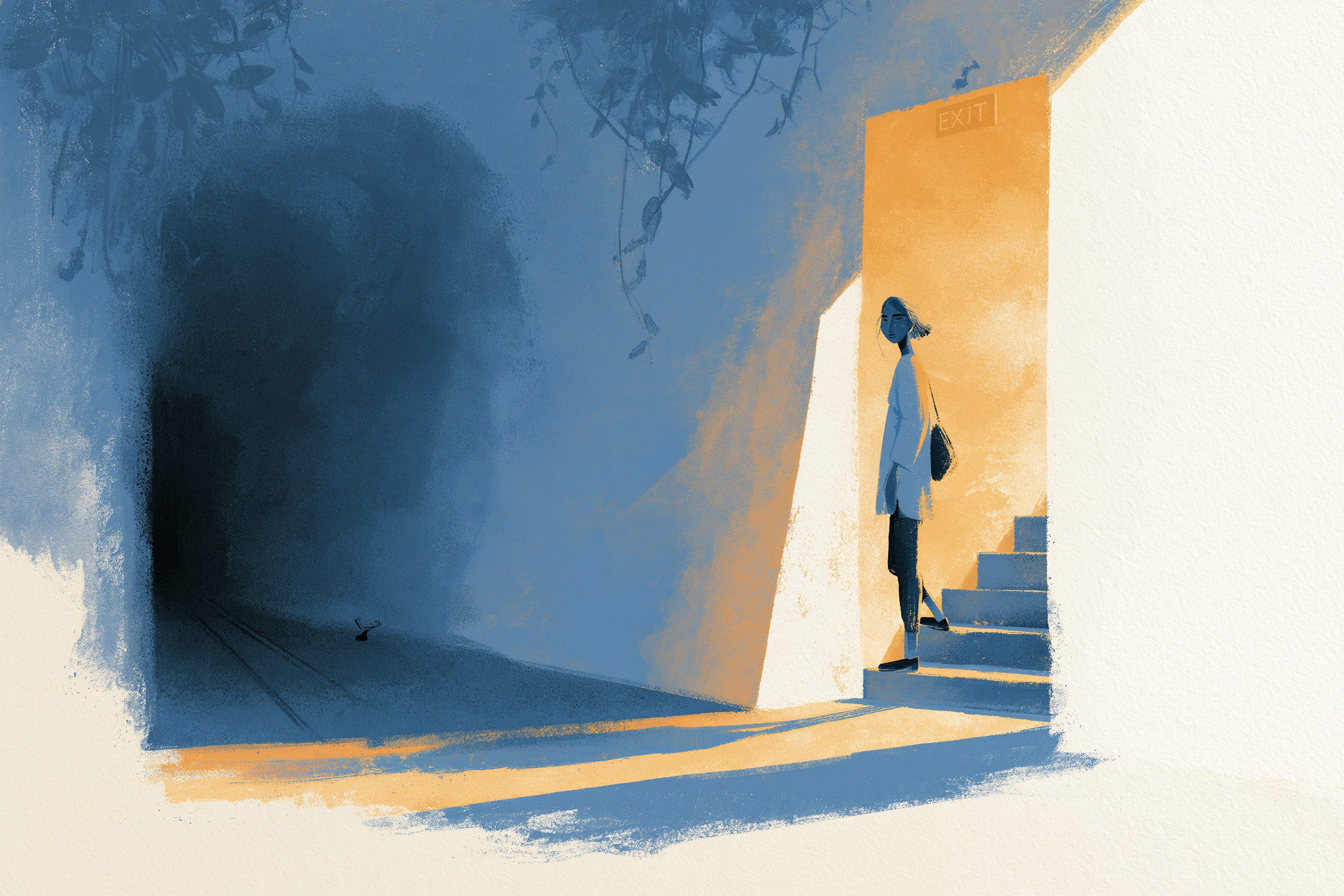
The relaunch cure
I know the move because I have just made it.
For most of a year I wrote this newsletter, and then I stopped. The stopping was not dramatic. I had less to say than the schedule demanded, and rather than sit with that, I let the gaps between pieces stretch until they became a silence, and the silence began to mean something. If I was not writing, I was not a writer. That was the equation, and I did not examine it. I just felt the floor go.
So I reached for the dropdown. I decided what I needed was a relaunch. A new name for the thing, a refreshed promise, a date in the calendar that would make me a writer again by making me a writer who was Coming Back. I told people. I made it official. And the moment it was official I felt worse than I had in the silence, which made no sense to me then and makes complete sense to me now.
The relaunch was a foreclosure. I had taken the first label that would close the question, “writer who is relaunching”, and committed to it without any of the exploring that might have told me whether it was true. It was a status, not a decision. It let me stand somewhere. It happened to be the wrong somewhere, chosen for the speed of the relief rather than the fit.
I have performed enough u-turns on this newsletter, quit then returned then quit again, to qualify me for Westminster. Each return came with a fresh label attached. And each label was a way of not admitting the plainer thing: that I did not know what this was yet, and was frightened that not knowing meant it was nothing.

The comfort of a box you chose
I do not have the answers. It is a strange thing to end on, but it is the truest available. What I have is smaller and more useful. A week ago I had no idea what to say here. Now I have more ideas than I can use, and the only thing that changed is that I stopped trying to name the thing that would produce them. The ideas were waiting on the other side of the label, not inside it.
So, no relaunch. I have announced enough of those. This is closer to the opposite: writing from where I actually am, rather than from wherever I have most recently decided to stand.
If you feel the pull towards a label right now, that is not a weakness. It is the standard equipment doing its job. But before you reach for the first one that fits, it is worth asking whether it fits, or whether it is only the nearest exit from the discomfort of not knowing. In the moment, those two feel identical. They are not.
Being without a label is uncomfortable. It is also, for a while, more honest than the alternative, which is climbing into a box you chose for the relief of its walls and calling that an identity. The box is warmer. It is still a box.
The teenage version was never a description of anything. It was a way of not standing in the open. The version worth having is the one you cannot select from a menu: the state that is accurately complicated, and left that way until it becomes something you have explored rather than something you grabbed.
It’s complicated. Leave it there for now.