

The Quiet Expert’s Guide to... being visible
Visibility isn’t about being loud. It’s about being found by the people who need what you know.

In a world that rewards performance, visibility feels like a betrayal of competence.
You’ve built your career on doing excellent work. You believe — perhaps naively, perhaps hopefully — that good work speaks for itself. That if you’re skilled enough, helpful enough, valuable enough, people will notice.
And yet they don’t. Or not enough. Or not the right people.
Meanwhile, people with half your expertise and twice your confidence are getting the opportunities, the clients, the recognition. Not because they’re better — but because they’re visible.
And you’re stuck in a maddening loop: you need to be more visible to grow, but visibility feels performative, inauthentic, exhausting. So you stay quiet. And staying quiet means staying stuck.
But this is what you NEED to know: in a digital economy, invisible expertise is functionally the same as no expertise at all. If people can’t find you, your skill doesn’t matter. Your depth doesn’t matter. Your years of experience don’t matter.
Visibility is no longer optional. It’s infrastructure.
Why this matters specifically for Quiet Experts
Quiet Experts face a specific visibility trap.
You’re watching people build audiences by posting daily, sharing every win, performing confidence they may or may not feel. And you think: I can’t do that. That’s not me.
You’re right. It’s not you.
But visibility doesn’t require you to become someone else. It doesn’t mean posting three times a day. It doesn’t mean sharing your morning routine or your revenue or your “hustle.” It doesn’t mean performing enthusiasm you don’t feel.
Visibility just means being findable by the people who need you.
The problem is that most advice on visibility comes from people who are naturally loud. Who love the spotlight. Who treat social media like performance art.
That advice doesn’t work for you — not because you’re doing it wrong, but because you’re optimising for different things.
Loud people optimise for reach. Quiet Experts optimise for resonance.
You don’t need a million followers. You need the right people to know you exist, understand what you do, and trust that you’re good at it.
That’s a different game. And it requires a different strategy.
What most people get wrong — and what Quiet Experts get right
Most people think visibility is about volume.
Post more. Show up more. Be everywhere. Play the algorithm. Hack your way to growth.
That approach works — if you’re willing to treat visibility like a full-time job. Most Quiet Experts aren’t. And you shouldn’t have to.
Visibility isn’t about how much you post. It’s about how clearly you’re positioned when someone goes looking.
Quiet Experts already understand something crucial: depth beats breadth. You’d rather have 100 people who truly get what you do than 10,000 who vaguely know your name.
That’s not a weakness. That’s strategic intelligence.
The framework below will help you build visibility that works for your temperament, not against it. Visibility that feels like an extension of your work, not a performance separate from it.
A practical framework for being visible without performing
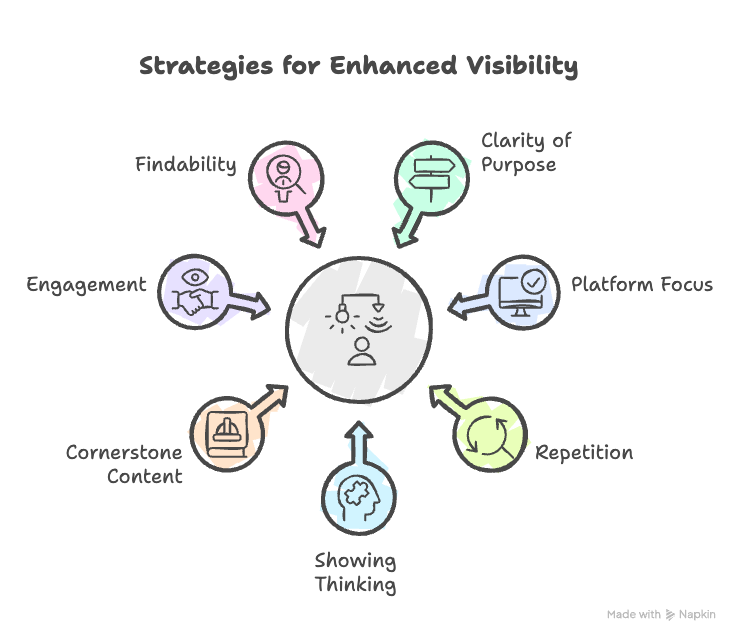
1. Get clear on what you want to be known for
Most people skip this step — and then wonder why their “visibility efforts” feel scattered and exhausting.
Before you post anything, write anything, or show up anywhere, answer this:
What do you want people to think of when they think of you?
Not “I’m a consultant.” Not “I help businesses grow.”
Specific. Clear. Memorable.
Examples:
“The person who helps B2B SaaS companies fix their onboarding.”
“The strategist who untangles messy positioning.”
“The coach who helps technical founders learn to sell.”
If you can’t finish this sentence, your visibility will be vague. And vague doesn’t get remembered.
Exercise:
Write down:
The problem I solve
Who I solve it for
Why I’m the person to solve it
Everything you do from here should reinforce that answer.
2. Choose one platform — and actually commit to it
This is where most people fail: they try to be everywhere.
LinkedIn and Twitter and Instagram and a newsletter and a podcast and a YouTube channel and—
Stop.
You don’t have the time. You don’t have the energy. And splitting your attention means you never build momentum anywhere.
Pick one platform. The one where your people actually are. The one that suits how you think and communicate.
If you’re B2B, that’s probably LinkedIn.
If you’re visual or creative, maybe Instagram.
If you think in long form, maybe Substack.
Commit to it for six months. Properly. Not “I’ll post when I feel like it.” Not “I’ll try this for a few weeks.”
Six months. Consistent presence. Then evaluate.
You can expand later. But master one first.
3. Visibility is about repetition, not variety
Here’s what Quiet Experts get wrong about visibility:
You think you need to have something new and brilliant to say every time you post.
You don’t.
Visibility is built through repetition. You need to say the same thing, in different ways, over and over again — until people associate that idea with you.
Most people need to hear something 7–10 times before they remember it. That means you’re not repeating yourself. You’re teaching.
Example:
If your core message is “Most businesses don’t have a marketing problem, they have a clarity problem,” you don’t say it once and move on.
You say it:
As a standalone post
As a case study
As a framework
As a response to someone else’s content
As the opening of a longer article
As a pull quote with a visual
Same idea. Different expressions. That’s not repetition. That’s positioning.
4. Show your thinking, not just your conclusions
Most people post their final answer. The polished take. The finished framework.
That’s not how you build connection.
Connection happens in the middle — where you’re still figuring it out, where you’re questioning an assumption, where you’re testing an idea.
Quiet Experts are well-positioned for this, because you do think deeply. You just don’t usually share that process.
Start sharing it.
Instead of: “Here’s my 5-step framework for X.”
Try: “I’ve been thinking about why X keeps failing for people. Here’s what I’m noticing…”
The first is a lecture. The second is an invitation. People engage with invitations.
5. Create one cornerstone piece — then reference it everywhere
Most people treat every post as standalone. That’s exhausting and inefficient.
Instead: create one cornerstone piece of content — a longer article, a framework, a detailed guide — that captures your core thinking on your main topic.
Then reference it constantly.
Every post you write can either:
Build toward that cornerstone
Build out from that cornerstone
Link back to that cornerstone
This does three things:
It makes visibility easier — you’re not starting from scratch every time
It builds authority — people see you return to your core ideas with depth
It creates a “home base” — when someone finds you, they know where to go next
Example:
Your cornerstone: “The 3 Clarity Questions Every Business Needs to Answer”
Your posts:
“Most marketing fails because of Question 1…”
“Here’s how to answer Question 2 if you’re in a crowded market…”
“A client came to me stuck on Question 3. Here’s what we did…”
Every post deepens the cornerstone. Every post sends people back to it.
6. Engage more than you post
Visibility isn’t just about posting. It’s about being present.
If you only show up to broadcast your own content, you’re not building visibility. You’re building a feed.
Visibility happens in other people’s comment sections.
When you:
Add a thoughtful comment to someone else’s post
Answer a question in a way that shows your expertise
Challenge an assumption respectfully
Share a relevant experience
You’re visible. And you’re visible in context — which means people see your thinking, not just your headline.
Aim for this ratio:
For every 1 thing you post, engage with 3–5 other pieces of content.
That’s how you build presence without burning out.
7. Make it easy for people to find you (everywhere)
You’d be surprised how many people do visibility work — and then make it hard to be contacted.
Check:
Is your LinkedIn headline clear about what you do? (and if not - this guide should help!)
Does your bio explain who you help and how?
Is there a way to contact you that doesn’t require DM’ing?
If someone Googles your name, do they find the right things?
Do you have one clear next step for someone who wants to work with you?
Visibility isn’t just about being seen. It’s about being findable and contactable when someone decides they need you.
8. Batch your visibility work
One reason visibility feels exhausting is because people treat it like a daily performance.
You sit down every morning thinking, “What should I post today?”
That’s a recipe for burnout.
Instead: batch it.
Set aside 2–3 hours once a month. Write 4–6 posts. Draft 2–3 longer pieces. Capture 10 ideas you want to explore.
Then schedule them. Show up to engage, but not to create from scratch every day.
This removes the performance pressure. You’re not scrambling. You’re just executing a plan.
9. Let your work be visible
If you’re doing excellent work for clients, that work can be visible too — with their permission.
Examples:
A case study (anonymised if needed)
A “here’s what I learned working with X” post
A testimonial you share with context
A before/after (results, not identities)
Your best marketing is proof that you’ve done this before. Let people see it.
10. Accept that visibility is a long game — and that’s fine
You’re not trying to go viral. You’re trying to be remembered.
That doesn’t happen in a week. It happens over months and years of consistent, clear, valuable presence.
You won’t wake up tomorrow with 10,000 followers. But in six months, the right people will know who you are. In a year, they’ll be reaching out. In two years, you’ll have opportunities you didn’t chase — because people found you.
That’s the visibility that lasts.
The Quiet Expert approach: build presence, not performance
Being visible doesn’t mean being loud.
It means being clear, consistent, and findable by the people who need what you know.
It means showing your thinking, not performing your confidence.
It means being present in conversations, not just broadcasting from a podium.
You don’t need to post every day. You don’t need to share your revenue or your morning routine or your “journey.” You don’t need to become someone else.
You just need to make it easy for the right people to find you — and trust that when they do, your depth will speak for itself.
Visibility isn’t about volume. It’s about positioning.
And Quiet Experts are very, very good at positioning — once they stop apologising for taking up space.
Call to action
Pick one thing from this guide and commit to it for the next 30 days:
Clarify what you want to be known for
Choose one platform and post consistently
Create one cornerstone piece of content
Engage with 3 pieces of content for every 1 you post
Batch your visibility work so it’s not a daily scramble
Then come back and tell me: what shifted? What felt hard? What surprised you?
Because visibility isn’t a one-time fix. It’s a practice. And the more we share what’s working — and what’s not — the easier it gets for all of us.
This is such a refreshing reframe, Claire! I love how you separate visibility from volume and performance. Being findable by the right people feels far more sustainable than trying to be everywhere at once. This kind of presence respects both the work and the person doing it.