

The Quiet Expert’s Guide to... being remembered in 3 sentences
How to write a compelling bio without rambling, underselling yourself or cringing in the process.

Most people write about themselves like they’re apologising for taking up space.
Why this matters
You write more paragraphs about yourself than you’d like to admit. The top of your LinkedIn. Your email signature. The bio in your deck. The “about” section on your website. Conference programmes. Pitch documents. Funding applications. Introduction emails.
Each time, you face the same uncomfortable task: distil your expertise, credibility, and value into 75-150 words that make someone want to keep reading.
And most people fail at it. Not because they lack credentials, but because they approach it like a CV in prose form: a chronological list of roles, wrapped in modest language, drained of personality, indistinguishable from everyone else in their field.
Research shows the average human attention span for digital content is 8 seconds. LinkedIn’s own data reveals that profiles with a strong “About” section receive 5x more connection requests and 3x more InMail responses than those without.
You have one paragraph to establish credibility, signal differentiation, and give someone a reason to care. Most people waste it.
Why this matters for Quiet Experts
You’re already uncomfortable writing about yourself. The performative humility expected of women and marginalised professionals makes it worse. So does the guru industrial complex, where everyone’s a “thought leader” and “passionate changemaker” who “helps ambitious entrepreneurs unlock their potential.”
That language feels borrowed. Inflated. Vague. So you retreat into minimalism: your job title, your years of experience, maybe a credential. Safe. Forgettable. Invisible.
Or you overcompensate — listing every project, client, and qualification, hoping volume will convey authority. It doesn’t. It conveys anxiety.
The Quiet Expert’s challenge is this: how do you establish authority without performing? How do you differentiate without exaggerating? How do you write about yourself in a way that feels true and still gets read?
What most people get wrong
Most bios follow this structure:
“[Name] is a [job title] with [number] years of experience in [field]. [They] have worked with [impressive client list] and specialise in [vague capability]. [They] are passionate about [abstract concept].”
This approach fails for three reasons:
1. It’s descriptive, not distinctive.
Every consultant has “15 years of experience.” Every designer has “worked with leading brands.” Every coach “helps clients achieve their goals.” None of this tells me what makes you different.
2. It’s backwards-facing, not forward-signalling.
A bio isn’t a CV. A CV proves you were qualified for past roles. A bio signals what you’re useful for now. Hiring managers and collaborators don’t care where you’ve been — they care whether you can solve the problem in front of them.
3. It prioritises credentials over clarity.
Listings of degrees, awards, and employers are social proof — but they’re not meaning. Cognitive psychology research shows that people remember stories and ideas 22 times more than facts alone. If your bio is just facts, you’re forgettable.
What Quiet Experts get right: you understand that the point of a bio isn’t to impress. It’s to orient. To give someone a clear, fast understanding of who you are, how you think, and why that matters to them.
A practical framework: the three-sentence bio structure
A strong bio does three things in quick succession:
Establishes your distinct expertise (what you do + how you do it differently)
Signals why that matters (the problem you solve, the outcome you create, the shift you enable)
Proves credibility without listing (social proof woven in, not appended)
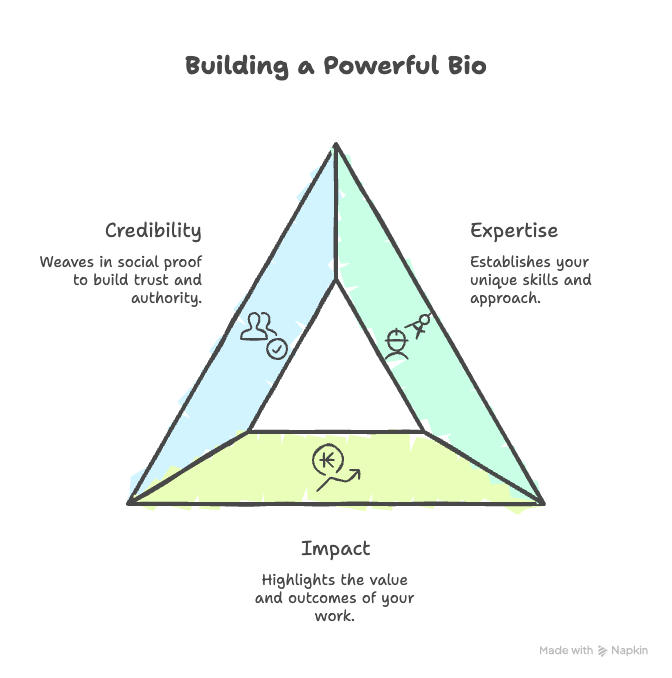
Here’s the structure:
Sentence 1: Expertise + differentiation
Formula: I [verb] [who/what] to [outcome/shift], by [how you think or work differently].
This sentence does the heavy lifting. It positions your expertise and signals your methodology or perspective in the same breath.
Weak:
“Sarah is a marketing consultant with 12 years of experience.”
Strong:
“I help technical founders turn complex products into clear market positions, without dumbing down what makes them valuable.”
Why it works:
Identifies who you serve (technical founders)
Names the transformation (complex → clear)
Signals your perspective (without dumbing down = you respect nuance)
Sentence 2: Context or proof (not a list)
Formula: I’ve [notable work or pattern] that shows [credibility or depth].
This is where you weave in clients, outcomes, or patterns — but sparingly, and with specificity.
Weak:
“I’ve worked with Google, Amazon, and Microsoft.”
Strong:
“I’ve led go-to-market strategies for three B2B SaaS companies from seed to Series B, including two that reached $10M ARR in under 18 months.”
Why it works:
Specific (not “worked with” but “led”)
Outcome-focused ($10M ARR, 18 months)
Pattern-based (three companies, repeated success)
Sentence 3: Perspective or invitation (optional but powerful)
Formula: I believe [perspective] / I write about [topic] / I’m currently [project or focus].
This is where you signal how you think or what you’re focused on now. It’s the difference between a static bio and one that feels alive.
Examples:
“I believe most ‘culture problems’ are actually systems problems in disguise.”
“I write about building authority without performing, and what leadership looks like when you’re not loud.”
“I’m currently working on a framework for pricing expertise without hourly rates.”
Why this works:
Research on interpersonal perception shows that people assess warmth and competence simultaneously. Sentence 1 establishes competence. Sentence 3 establishes perspective — which signals both intellectual depth and relatability.
Putting it together: examples
Example 1: Consultant
“I help finance leaders in scaling startups build reporting systems that boards actually trust, without needing a full-time CFO. Over seven years, I’ve worked with 30+ companies from pre-seed to Series B, including three that went on to successful exits. I believe financial clarity is a competitive advantage, not a compliance exercise.”
Example 2: Designer
“I design brand systems for founders who know what they’re building but can’t explain it visually. I’ve led identity work for early-stage companies in climate tech, AI infrastructure, and biotech — sectors where clarity isn’t optional. I’m interested in what happens when design does the explaining your website copy can’t.”
Example 3: Operator
I work with high-performing, underestimated leaders to translate operational excellence into visible leadership impact, using structured systems for decision-making, communication, and recognition. I’ve built my career in operations, where results are real, standards are high, and the best work often goes unnoticed. My focus is helping Quiet Experts become legible at senior level — without turning leadership into theatre. (sound familiar…?)
What to avoid
❌ Vague capability claims:
“Passionate about innovation.” “Driven to make an impact.” “Committed to excellence.”
These mean nothing. Cut them.
❌ Exhaustive lists:
“I specialise in strategy, operations, go-to-market, fundraising, culture, hiring, and product.”
If you do everything, you signal nothing.
❌ Hedging language:
“I try to help...” “I’m passionate about supporting...” “I hope to...”
Write with certainty. You do the thing. Say so.
❌ Third person when writing about yourself:
“Jane is a consultant who helps...”
Unless it’s required by a specific format (conference programmes, etc.), use first person. It’s warmer, clearer, and more confident.
How to test your bio
Read it aloud. Then ask:
Would I remember this person 20 minutes after reading it?
If not, you need more specificity or perspective.Can I tell what problem this person solves?
If not, your expertise isn’t clear enough.Does this sound like a human or a LinkedIn algorithm?
If the latter, cut the performance language.Would someone in my field recognise how I’m different?
If not, you haven’t differentiated.Does this make someone want to keep reading, or does it close the loop?
A good bio creates curiosity. A bad one feels complete — which means there’s no reason to engage further.
If you want to pressure-test your own bio, I built a simple prompt that will critique it for clarity, specificity, and distinctiveness — and rewrite it in three stronger versions. Copy, paste, and try it on yours.
You are an experienced editor and positioning strategist. Your task is to critique and rewrite a short personal bio (75-150 words) to make it:

Clear, specific, and memorable
Distinctive and differentiated from others in the field
Focused on the key problems the person solves for their target audience
Confident in tone without exaggeration or self-promotion
Professional and polished, free of jargon or "thought leader" language
The bio should follow a 3-sentence structure:

Expertise + Differentiation: I [verb] [who/what] to [outcome/shift], by [how I work differently].

Context or Proof: I've [pattern of work or specific outcome] that demonstrates my credibility.

Perspective or Invitation (optional): I believe [perspective] / I write about [topic] / I'm currently focused on [work].

Provide the following for the given bio paragraph:

First impression (8-second test)
Clarity check (who they help, what outcome, what makes them different)
What's working well
Weaknesses to address (vague claims, generic phrasing, excessive credentials, hedging, jargon, lack of differentiation)
3-5 concrete improvements
3 rewritten versions: A) Clear + minimal, B) More distinctive + perspective-led, C) Stronger executive/operator tone
1-sentence signature line suggestionThis is how you become findable
Authority isn’t built through credentials alone. It’s built through clarity about what you do, how you think, and why that matters.
The Quiet Expert’s advantage is that you don’t need to oversell. You just need to orient. When someone reads your bio, they should think: “Ah. That’s who you are. That’s what you’re for.”
Not impressive. Not humble. Just clear.
That clarity is what makes people reach out, remember you, and refer you. Write a bio that does that work, and you’ll stop needing to rewrite it every six months because it doesn’t feel like you.
Start here
Open the “About” section of your LinkedIn. Read the first paragraph. Does it follow this structure? Does it differentiate you?
If not, rewrite it today using the three-sentence framework and check it with the prompt shared above.
Then share it here. Post your new bio, or screenshot the before and after. Let’s see what happens when Quiet Experts stop apologising and start orienting.