

The Quiet Expert’s Guide to... Introductions
How to introduce yourself with clarity, authority, and calm presence.

Most people introduce themselves in ways that shrink their expertise or inflate it—both make them forgettable.
First impressions… do matter.
An introduction is a professional hinge point. It determines whether a conversation opens or closes.
Research shows:
People form impressions within 0.1–0.3 seconds of meeting someone.
First statements shape perceived competence more than job titles alone.
In digital spaces, profiles with clear self-descriptions receive up to 30% more meaningful engagement.
In short: an introduction isn’t a formality. It’s a strategic asset influencing trust, opportunity, and the trajectory of a relationship.
Introductions without performance
Quiet Experts face a distinct tension: we carry depth, but we don’t perform it.
This creates unique challenges:
Confidence theatre is rewarded; substance often isn’t.
Underselling is interpreted as lack of competence, not modesty.
Your work is nuanced, and oversimplifying it feels untrue.
Overexplaining sounds uncertain, even when it comes from integrity.
Your introduction must hold authority without performance, clarity without compression, and presence without preamble.
It’s not what you do, it’s why it matters.
An introduction is not a biography. It’s a positioning statement.
Most people get it wrong by:
Leading with their job title.
Delivering a narrative that starts in 2012 for no reason.
Over-qualifying themselves (“I sort of…”, “I guess I…”).
Dropping random personal facts to “seem human”.
A Quiet Expert gets it right by:
Naming their work in grounded, specific terms.
Framing the value they create, not a laundry list of tasks.
Using clarity to signal depth.
Adding context that makes them memorable, not quirky.
The practical framework
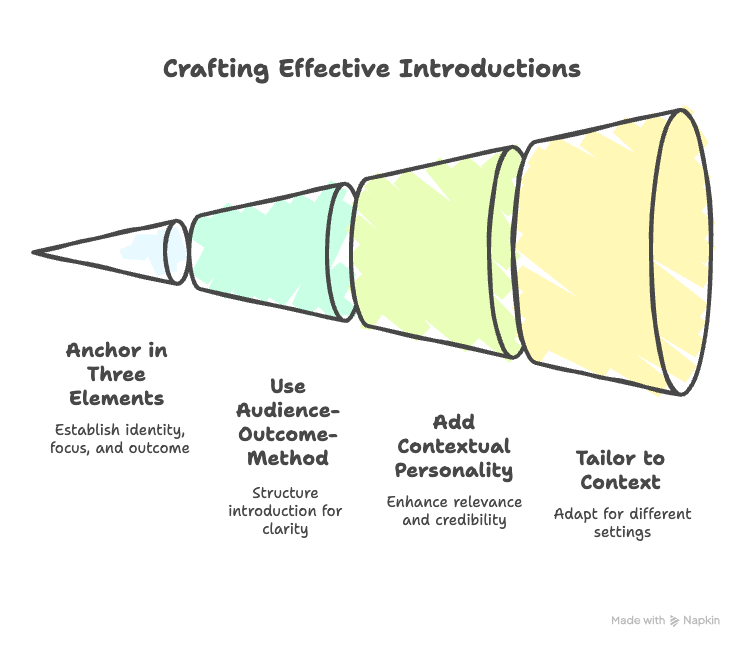
1. Anchor your introduction in three elements
Two sentences is enough.
Identity: Who you are in simple, credible terms.
Focus: The problems you help solve.
Outcome: What consistently improves because of your work.
Example:
“I’m a leadership and operations partner for early-stage founders. I help teams build the systems and decision-making rhythms that let them scale without burning out.”
2. Use the “Audience + Outcome + Method” structure
Audience: Who you support.
Outcome: The improvement they experience.
Method: How you help them get there.
Template:
“I work with [audience] to help them [outcome] through [method].”
3. How to add personality—without derailing the introduction
Quiet Experts often avoid adding anything personal because it feels irrelevant. Others often add personal details that feel random. Both miss the point.
The goal is contextual personality: a detail that reinforces your identity, method, or worldview.
A useful personal detail should do one of three things:
Signal your operating philosophy
“I’m a strategist by background, but most of my thinking happens on long runs.”
→ running is not a hobby here; it signals reflection, pace, systems thinking.Add human texture that supports credibility
“I have two young children, so I design leadership systems that work in real life, not ideal conditions.”
→ children aren’t a fun fact; they explain pragmatism and time realism.Strengthen your positioning through lived context
“I grew up in a family business, so I think about operations through the lens of sustainability, not speed.”
→ background becomes a lens, not trivia.
What it’s not:
“I love cheese.”
“I’m obsessed with my dog.”
“I run marathons for fun.”
Unless they reinforce how you think or how you work, they are noise.
Use this formula:
Identity + Outcome + Contextual cue
Example:
“I’m an organisation design partner for high-growth teams. I help them scale with clarity and calm—and as a parent, I’m ruthless about building systems that don’t fall apart under pressure.”
Memorable, human, relevant.
4. Introductions for different contexts
1. The Meeting Roundtable
“I support COOs and founders to create operational clarity and sustainable pace.”
2. A Conference or Event
“My work focuses on organisation design and leadership operations. I help growing teams scale with clarity and calm.”
3. Written Introductions (LinkedIn, email, messages)
“I’m a strategist and operator specialising in scaling teams from 10–200. I design the systems, structures, and leadership habits that let organisations grow without chaos.”
4. Adding Contextual Personality in a Sentence
“…and because most of my thinking happens on long walks with a buggy, I design systems that work in the real world, not just the ideal one.”
5. Prompts to sharpen your introduction
What is the simplest, truest statement about my work?
What outcome do people consistently experience when they work with me?
What context from my life or personality reinforces—not distracts from—my worldview?
Would a tired founder understand this instantly?
Does this sound like me without sounding small?
6. Checks before you say it out loud
Clarity: Could someone repeat it back accurately?
Authority: Competence without performance.
Relevance: Does it help the listener understand how you fit into their world?
Calm presence: No rambling, no apology, no theatrics.
Over to you
Draft one introduction using:
Identity → Outcome → Method → Contextual personality cue (optional).
Say it aloud. Trim until it feels clean and true.
Share it!
What’s the most grounded, memorable introduction you can offer right now?
Absolutely loved this! It really hit home for me - I start a meeting feeling totally confident with my intro, then suddenly it’s my turn again and I’m having a full-on internal wobble. The idea of using contextual personality is brilliant, and that running example really speaks to how I like to operate. Definitely giving that a go next time!