

The Quiet Expert’s Guide to Overthinking
How to tell the difference between foresight and self-sabotage

The problem isn’t that you overthink. It’s that you use the same depth of thinking in situations that don’t require it.
Why this matters
Overthinking gets a bad reputation. We’re told to “just decide,” “trust our gut,” “stop spiralling.” As if thinking deeply is inherently the problem.
It’s not.
For most of your life, thinking ahead has saved you. It’s prevented avoidable mistakes. It’s spotted consequences others missed. It’s made you reliable, trusted, rarely reckless.
Overthinking is why you’re good at what you do.
The issue isn’t that you think too much. It’s that you apply the same rigorous, multi-layered thinking to decisions that don’t warrant it — and then wonder why you feel exhausted.
Why this matters specifically for Quiet Experts
Quiet Experts don’t overthink because they’re anxious. They overthink because they’re deliberate.
You re-read emails multiple times before sending. You rewrite messages that were already clear. You mentally rehearse meetings that may never happen the way you’ve imagined. You play out every possible reaction before you speak.
Not because you lack confidence. Because you care about getting it right.
This isn’t insecurity. It’s systems thinking applied to every decision — including the ones that don’t need it.
And that’s the trap.
You feel slow. Not because you lack clarity, but because your mind is already three steps ahead, mapping variables, considering edge cases, anticipating reactions.
Meanwhile, people with half your insight move faster — not because they’re smarter, but because they don’t mistake every decision for a consequential one.
What most people get wrong — and what Quiet Experts get right
Most people think overthinking is a flaw to eliminate.
It’s not.
Overthinking is pattern recognition operating at depth. It’s a gift — when applied to the right problems.
Where overthinking works brilliantly:
Stakes are real and long-term
Decisions are hard to reverse
There are multiple interacting variables
The cost of getting it wrong is high
This is where Quiet Experts shine. You see the full decision landscape, not just the obvious path.
But overthinking becomes counterproductive when:
The decision is low-risk or reversible
The scenario exists only in your head
You’re optimising for perfect reception instead of clear action
Thinking replaces doing
The difference isn’t always obvious. So you default to depth — every time.
And that’s where energy leaks.
The framework: When to overthink — and when not to
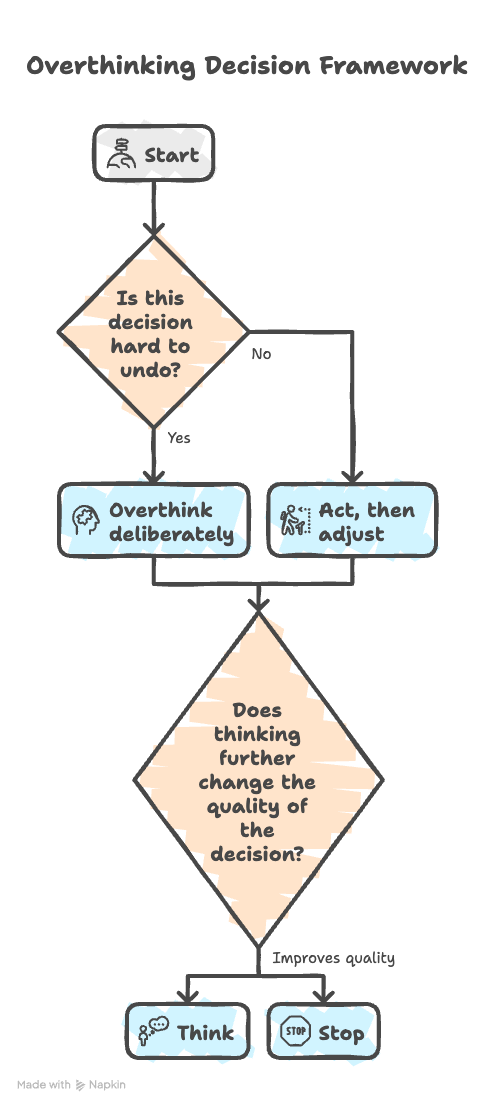
Before you let your mind run, ask two questions:
1. Is this decision hard to undo?
Yes → Overthink deliberately.
No → Act, then adjust.
2. Does thinking further change the quality of the decision — or just delay it?
Improves quality → Think.
Only delays action → Stop.
That’s it.
You’re not banning overthinking. You’re directing it.
What this looks like in practice
Decide once which things deserve depth:
Career moves. Values. Boundaries. Long-term strategy.
Create defaults for low-stakes decisions:
Emails don’t need five drafts. Posts don’t need to be perfect. Small choices don’t need deep analysis.
Notice when you’re rehearsing to avoid discomfort:
Are you thinking to improve the outcome — or to delay the feeling of vulnerability?
Treat action as data, not a final verdict:
You don’t have to get it right the first time. Action gives you information that thinking alone can’t.
Key shift:
Action doesn’t cancel thought. It completes it.
The Quiet Expert approach: aim your thinking
Overthinking is not something Quiet Experts need to “fix.”
It’s something to aim.
The goal isn’t to think less. It’s to think where it matters — and move where it doesn’t.
You already know how to think deeply. The skill you’re building now is knowing when depth is required — and when it’s just you delaying the discomfort of action.
Mastering overthinking isn’t about quieting your mind.
It’s about trusting when you’ve already thought enough.
Call to action
Think of one decision you’re currently overthinking.
Now ask:
Is this hard to undo?
Will more thinking change the quality — or just delay the action?
If the answer to both is no — act today.
Send the email. Make the choice. Post the thing. See what happens.
Then come back and tell me: what surprised you? What did action teach you that thinking couldn’t?
Reply, message, or share. Because the more we practice aiming our thinking — instead of fearing it — the easier it gets.
Very well laid out. Deciding what needs deeper thinking - filtering out the noise - is the key.
This is such good advice! It’s all about using the right energy in the right places, not to treat every aspect the same. Well done on framing this and giving actionable takeaways!