

The Quiet Expert’s Guide to... turning what you know into social media posts
If LinkedIn gives you the heebie-jeebies - this is a good place to start.

“I know I should show up more online. I just don’t know what to say”
You've been told to "add value" and "show up consistently" and "build your personal brand." But no one told you what that actually looks like.
And now you’re lurking online, looking at others post their lives - and let’s be honest, probably judging them a bit.
And yet - YET - you still know, deep down, that you should probably join in.
Why this matters
Visibility isn’t vanity. It’s infrastructure.
When you don’t share your thinking, your expertise stays locked inside direct conversations, client work, and internal decisions. Your ideas help the three people in the room — but not the three hundred who need them. You stay unknown not because you lack skill, but because you’ve made your knowledge invisible.
And here’s the cost: opportunities go to people who sound confident, not people who are capable. Partnerships form around familiarity, not competence. Your competitors aren’t better than you — they’re just louder.
The data confirms what you already suspect: only 1% of LinkedIn's 900 million users post weekly. But those who do report 3x more profile views, 5x more connection requests, and measurably more inbound opportunities than lurkers with identical experience. The correlation between visibility and opportunity isn't subtle — it's structural.
Why this matters for Quiet Experts
You don’t care much for likes and ‘reposts’. You aren’t seeking to go viral. But you’re starting to notice a subtle shift of opportunities going to those who are more visible, of their capabilities being recognised over yours. Even though you’d rather solve the problem than talk about solving it, you’re starting to wonder if you might have to do both.
The guru framework doesn’t work for you. You’re not going to post selfies with captions about resilience. You’re not going to manufacture relatability or narrate your morning routine. You don’t want to be a thought leader — you want to share useful things and get back to work.
So you stay silent. Or you post once, feel exposed, get modest engagement, and retreat for three months.
The real block isn’t fear. It’s clarity. You don’t know what belongs in public and what doesn’t. You don’t have a filter for “is this worth saying?” So you say nothing.
What most people get wrong
Most advice tells you to “just start posting” or “share your journey.” It frames posting as self-expression — which makes it feel self-indulgent.
But posting isn’t journaling. It’s knowledge transfer at scale. It’s taking what you already know and making it accessible to people who don’t yet know it.
What Quiet Experts get right: you understand that the goal isn’t attention. It’s utility. You’re not trying to be interesting — you’re trying to be useful. Once you know what to share, the discomfort shrinks. It’s not about you anymore. It’s about the idea.
A practical framework: six types of posts you already have material for
You don’t need new ideas. You need to recognise what you already think about as postable.
Here are six reliable structures. Choose one. Write it. Post it. Repeat.
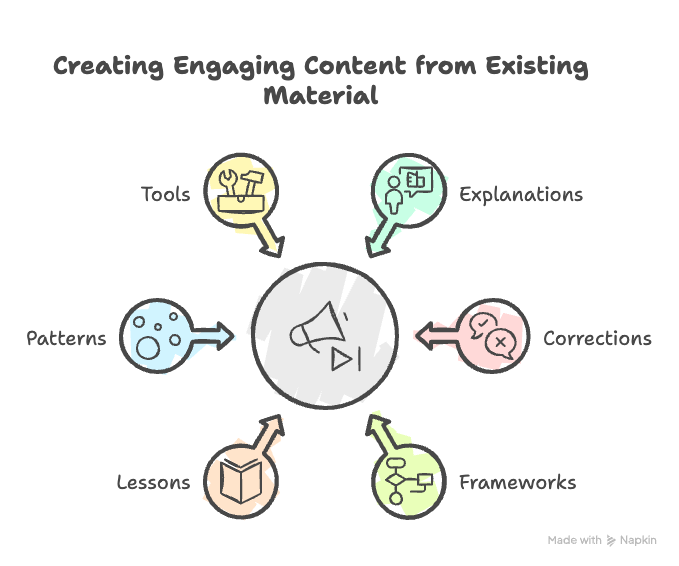
1. The thing you just explained to someone
You sent a voice note. You walked a colleague through a decision. You clarified a common misconception in a client call.
That explanation? That’s a post.
Prompt: “I was just explaining to someone why [x] doesn’t work the way people think. Here’s what I told them…”
Example: “A founder asked me yesterday why their LinkedIn posts weren’t landing. I asked what they were posting about. They said ‘my product.’ That’s the problem. No one cares about your product until they care about the problem it solves. Talk about the problem first.”
2. The thing most people get wrong
You see a pattern. A repeated mistake. A widely held belief that doesn’t match reality.
Correct it. With evidence, not smugness.
Prompt: “Most people think [x]. But in practice, [y]. Here’s why that gap exists…”
Example: “Most people think ‘thought leadership’ means having big ideas. It doesn’t. It means having clear ideas. The person who can explain a complex thing simply will always win over the person who makes a simple thing sound complex.”
3. The decision framework you use
You have systems. Principles. Shortcuts. Rules of thumb you apply when evaluating, prioritising, or choosing.
Share them.
Prompt: “When I’m deciding whether to [x], I ask myself three questions…”
Example: “Before I take on a new client, I ask: 1) Can I actually help them? 2) Will working with them make me better at what I do? 3) Do they take responsibility for outcomes, or are they looking for someone to blame? If it’s not three yeses, it’s a no.”
4. The thing you learned the hard way
You made a mistake. It cost you time, money, credibility, clarity. You adjusted. You don’t make that mistake anymore.
That’s a lesson. Share it without the performance.
Prompt: “I used to [x]. It didn’t work because [y]. Now I [z].”
Example: “I used to say yes to every speaking opportunity. I thought visibility was visibility. But most events gave me nothing — no clients, no connections, just exhaustion. Now I only say yes if the audience is decision-makers in my sector, or if I’m learning something new by preparing the talk.”
5. The pattern you’ve noticed
You work with multiple clients, projects, or teams. You see the same issue come up across different contexts.
Name the pattern. Explain why it happens. Offer a way forward.
Prompt: “I keep seeing [x] happen. Here’s what’s actually going on…”
Example: “I keep seeing founders under-price their first productised service because they’re afraid no one will buy. Then they get clients, burn out delivering it, and resent the work. The issue isn’t the price — it’s that they priced for getting clients, not keeping their sanity. Price for the life you want, not the one you’re willing to tolerate.”
6. The tool, resource, or method you actually use
Not everything you use. Just the thing that saves you hours, sharpens your thinking, or makes your work easier.
Name it. Explain when to use it. Link if relevant.
Prompt: “I use [x] for [y]. Here’s why it works…”
Example: “I use Hemingway Editor for every piece of client-facing writing. Not because my writing is bad, but because clarity is a competitive advantage. If I can say it in fewer words, I do.”
How to choose what to post
Not everything belongs in public. Here’s the filter:
✅ Post it if:
You’ve said it more than once
It clarifies something misunderstood
It saves someone time, money, or confusion
You’d be comfortable defending it in a room of peers
❌ Don’t post it if:
It’s venting
It requires twenty caveats
You’re trying to impress people rather than help them
It’s someone else’s insight poorly paraphrased
If you’re unsure, ask: “Would I want to read this if someone I respected wrote it?”
If yes, post it.
This is how authority is built
Not through performance. Through repetition of useful thinking.
You don’t need to be vulnerable. You don’t need to be loud. You need to be consistent and clear. The Quiet Expert’s advantage is this: you don’t say things to fill space. You say things because they’re worth saying.
That restraint is what makes people listen when you finally speak.
Start here
Pick one framework from this guide. Write one post using it. Publish it today — not next week, not when it’s perfect.
Then come back and do it again.
What’s one thing you explained to someone recently that you could turn into a post? Write it in the comments, or screenshot your draft and tag me. Let’s make your thinking visible.
Couldn't agree more, this perspective on visibility as infrastructure is brilliant and so crucial, thank you for articulatin' it so clearly!
What an excellent post! One of my favourite mantras (borrowed from the founder of Kit) is: “You don’t teach because you’re an expert. You’re an expert because you teach.” Providing utility is the secret, as you say.