

The Quiet Expert’s Guide to... Asking for what you want
How to negotiate, set boundaries, and advocate for yourself — without being pushy

Most people fail at negotiation before they even open their mouths — because they’ve already decided the answer is no.
Good things come to those who wait…?
Asking for what you want is one of the most fundamental skills in business and life. Whether it’s negotiating your rate, requesting a deadline extension, setting a boundary with a client, or asking for support from your team — your ability to articulate what you need directly shapes what you get.
And yet most of us are terrible at it.
We hedge. We over-explain. We apologise before we’ve even made the request. We frame our needs as inconveniences. We accept the first offer because asking for more feels greedy. We say yes when we mean no because saying no feels rude.
Research from Carnegie Mellon found that 57% of men negotiate their starting salary, compared to only 7% of women. That gap costs women an average of $500,000 over their careers. But the issue isn’t just gendered — it’s cultural. We’re taught that wanting things is impolite. That asking is pushy. That good things come to those who wait quietly.
They don’t.
Why this matters specifically for Quiet Experts
Quiet Experts are particularly vulnerable to this trap.
You’ve built your reputation on competence, not volume. You don’t want to be one of those loud, aggressive negotiators who bulldoze their way through conversations. You value relationships. You don’t want to seem difficult, entitled, or demanding.
So you stay quiet. You hint. You hope people will notice what you need and offer it without you having to ask.
And when they don’t — because they can’t read your mind — you resent them for it. Or worse, you resent yourself.
The truth is that not asking is still a choice. And it’s often the choice that costs you most.
The loudest people aren’t winning because they’re better than you. They’re winning because they’re willing to articulate what they want — clearly, confidently, without apology. You can do that too. You just need a different approach.
What most people get wrong — and what Quiet Experts get right
Most people think negotiation is about being pushy. It’s not.
It’s about being clear.
Pushiness is when you ignore the other person’s needs and bulldoze toward your own. Clarity is when you articulate what you need in a way that makes it easy for the other person to say yes.
Quiet Experts already understand something crucial: relationships matter. You’re not interested in burning bridges or winning at someone else’s expense. You want outcomes that work for everyone.
That’s not a weakness. That’s strategic intelligence.
The mistake is thinking that clarity and kindness are incompatible. They’re not. In fact, the kindest thing you can do is ask directly — because vagueness creates confusion, and confusion creates resentment.
When you ask clearly for what you want, you give the other person:
Information they can act on
Respect for their time and decision-making ability
Permission to say no (which makes yes more meaningful)
The framework below will help you ask for what you want without losing your integrity, your relationships, or your sanity.
A practical framework for asking for what you want
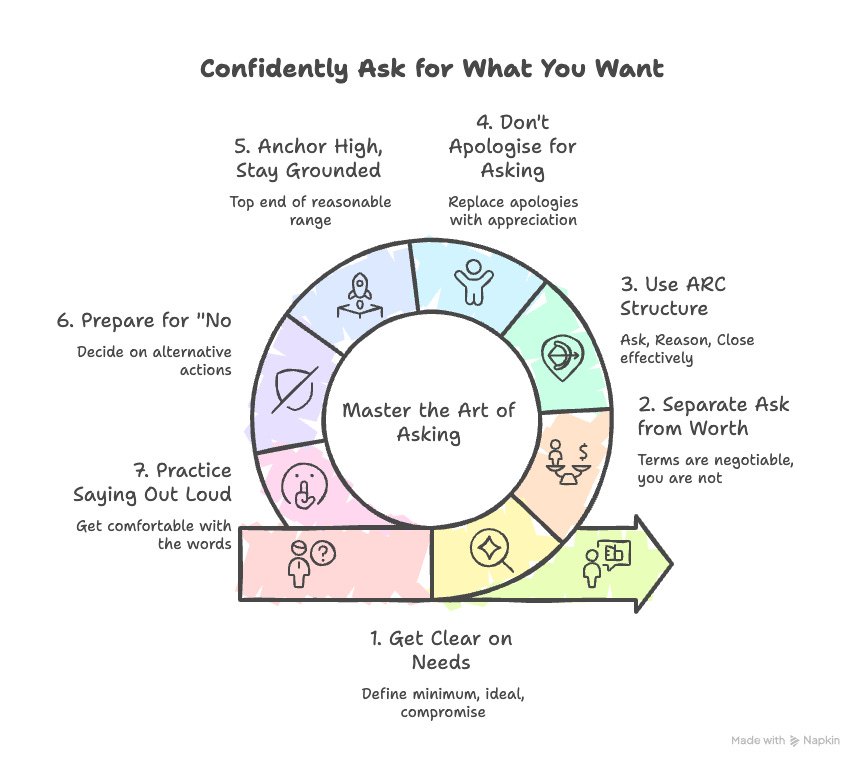
1. Get clear on what you actually want
Before you ask anyone else, ask yourself:
What do I actually need here?
What’s the minimum I’ll accept?
What’s the ideal outcome?
What am I willing to trade or compromise on?
Most negotiations fail because you haven’t done this work. You walk in fuzzy, hoping the other person will help you figure it out. They won’t.
Example:
Fuzzy:
“I’d like to talk about my rate.”Clear: “I want to raise my rate to £150/hour for new projects, effective next month.”
The clearer you are internally, the easier the external ask becomes.
2. Separate the ask from your worth
This is the psychological trap that stops most Quiet Experts before they start:
You think asking for more money means proving you’re worth more. So you prepare a defence. You gather evidence. You brace for rejection — because if they say no to your rate, they’re saying no to you.
They’re not.
Your worth is not up for negotiation. Your salary, your deadline, your boundary — those are just terms. Terms are negotiable. You are not.
When you separate the two, the emotional stakes drop. It’s no longer personal. It’s just business.
Reframe:
Not:
“Am I good enough to deserve this?”But: “Is this the right compensation for this work?”
3. Use the ARC structure: Ask, Reason, Close
Most people either under-explain (too vague) or over-explain (too apologetic). The ARC structure gives you exactly what you need:
A — Ask: State what you want, clearly and directly.
R — Reason: Give one clear, grounded reason why.
C — Close: Stop talking. Let them respond.
Example:
“I’d like to move my rate to £150/hour for new projects starting in January. I’ve been at my current rate for two years, and my expertise and the value I deliver have both grown significantly. Does that work for you?”
Then stop. Do not fill the silence. Do not backtrack. Do not apologise. Let them think.
Why this works:
You’ve been clear (they know exactly what you’re asking)
You’ve been reasonable (you’ve given context, not excuses)
You’ve made it easy to respond (yes, no, or counteroffer)
4. Don’t apologise for asking
This is the habit that undermines everything:
“I’m so sorry to bother you, but I was wondering if maybe, possibly, it might be okay if I asked about…”
Stop.
Apologising signals that you don’t believe you deserve what you’re asking for. It invites the other person to agree with you.
Replace apologies with appreciation:
Not:
“Sorry to ask, but could we push the deadline?”But: “Thanks for being flexible — could we push the deadline to Friday?”
Appreciation assumes goodwill. Apology assumes you’ve done something wrong. You haven’t.
5. Anchor high, but stay grounded
In negotiation research, the first number sets the range. If you open low, the negotiation stays low. If you anchor high, you create room to land somewhere good.
But “high” doesn’t mean delusional. It means the top end of reasonable.
Example: If your current rate is £100/hour and market rate is £120–150, don’t ask for £250. But don’t ask for £110 either. Ask for £150. If they counteroffer £130, you’re still ahead.
This works because:
It signals confidence
It gives you room to negotiate down (if needed)
It trains you to stop undervaluing yourself
6. Prepare for “no” — and have a plan
The fear of hearing “no” is what stops most people from asking. So remove the fear: decide in advance what you’ll do if they say no.
Ask yourself:
If they say no, will I walk away?
Will I accept it and revisit later?
Will I offer an alternative?
When you know your plan, “no” stops being a catastrophe. It’s just information.
Example response to “no”:
“I understand. Let me ask — is it the rate itself, or the timing? I’m happy to hold my current rate through this project and revisit in three months.”
This keeps the conversation open. It shows you’re flexible without being a pushover.
7. Practice saying it out loud
This sounds small. It’s not.
Most people practice the ask in their head — where it sounds perfect. Then they open their mouths and it comes out garbled, apologetic, or defensive.
Say your ask out loud. Multiple times. Before the conversation.
Say it to your mirror. Say it to a friend. Say it in the shower. Get comfortable with the words in your mouth.
Because if you can’t say it confidently, no one else will believe it.
The Quiet Expert approach: clarity is kindness
Asking for what you want isn’t selfish. It’s not aggressive. It’s not pushy.
It’s clear communication. And clarity is one of the kindest things you can offer.
When you ask directly:
You respect the other person’s time
You give them the information they need to make a decision
You build trust, because they know where they stand with you
Quiet Experts don’t need to be loud to get what they want. But you do need to be clear. You do need to advocate for yourself. You do need to stop waiting for someone else to notice.
Ask clearly. Ask confidently. Ask without apology.
And then stop talking.
Your turn:
Think about one thing you’ve been wanting to ask for — but haven’t.
A rate rise. A boundary. A deadline shift. Support from your team. A conversation you’ve been avoiding.
Now write down your ARC:
Ask: What do you want?
Reason: Why is this reasonable?
Close: How will you stop talking and let them respond?
Practice it out loud. Then ask.
If you try this, I’d love to know how it goes. What did you ask for? What happened? What surprised you?
Reply, message, or share. Because the more we practise asking clearly, the easier it gets — for all of us.
Such an important article, especially for women to read. Loved the point to simply “stop” and say no more. We often over-explain rather than let the words hold in the air.
I used to tell my team members, “don’t be afraid to ask for what you want, so I know where you want to go and can help make that happen”.